★★★★Jordan P.
Does the job. Splitting it per trip rather than one big total is what makes it useful — you can see which half of the plan is the expensive half.
It earns its place when one family is a long way further than the other, you are both paying for different parts of it, and December has a number attached to it that you have already quietly gone past once before.
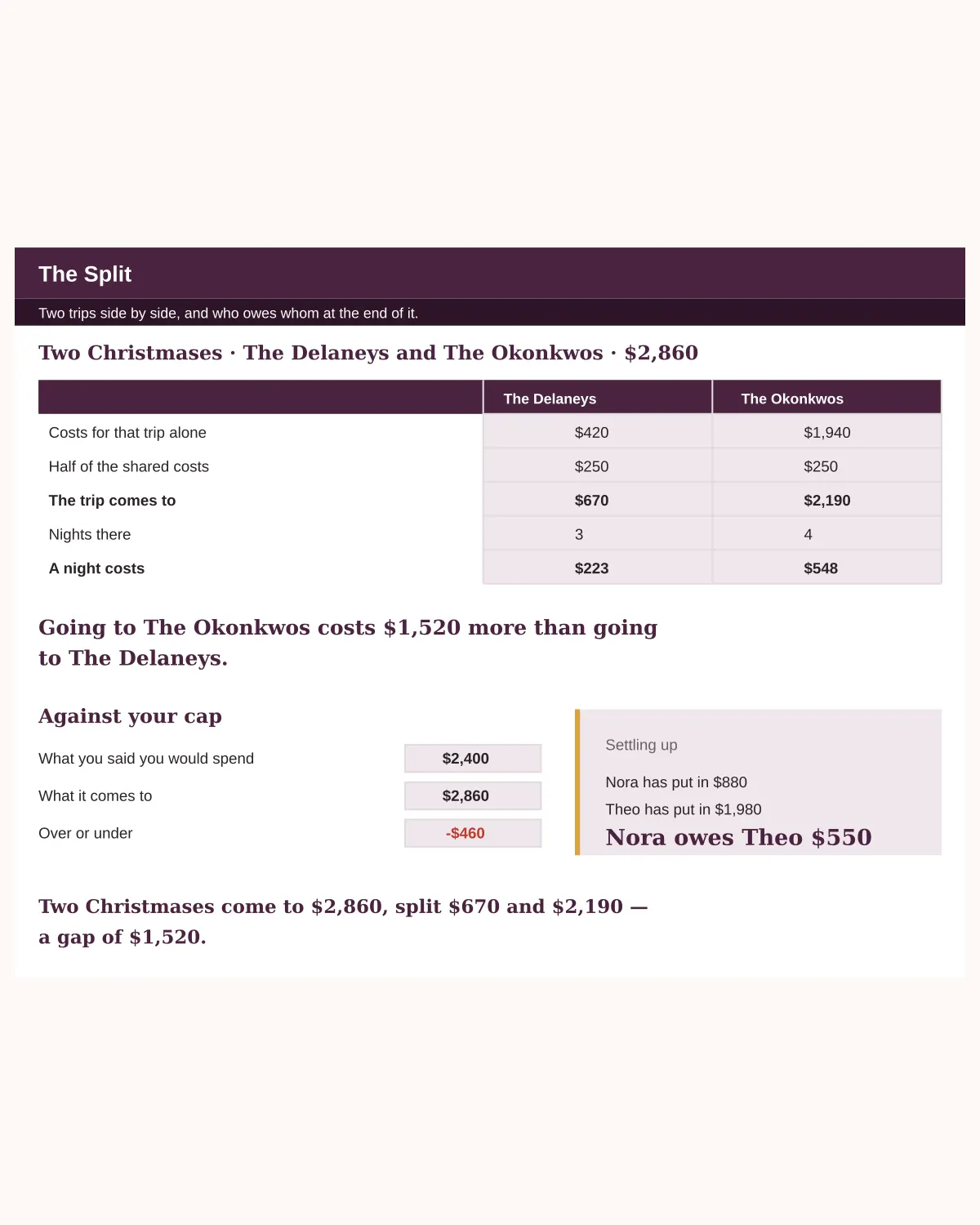
Two families, two trips, one budget. This puts both in the same place, halves the costs that belong to neither, shows what each trip really comes to per night, and works out who owes whom when it is over.
The flights go on a card in September because the fare looked good. The motel gets booked in November. Somebody pays the kennels. Somebody else pays for the rental car at the airport. None of it is written down in one place, because none of it happened on the same day. Then January arrives with a statement, and the conversation that follows is not really about money. It is about whose family, how far, how many nights, and who paid for what — four separate arguments wearing one coat. All four have answers. They are just spread across two months and three cards.
What each trip actually comes to, with the shared costs halved, and the distance between the two. It is geography, not favouritism, and it reads better as a number than as a feeling. A trip total is abstract. A night is not. Four nights at five hundred and forty dollars is a sentence that leads somewhere — one night fewer, or driving, or accepting it out loud. Every line has a payer. At the bottom it adds up what each of you has actually put in, joint money included, and names the one number that squares it.
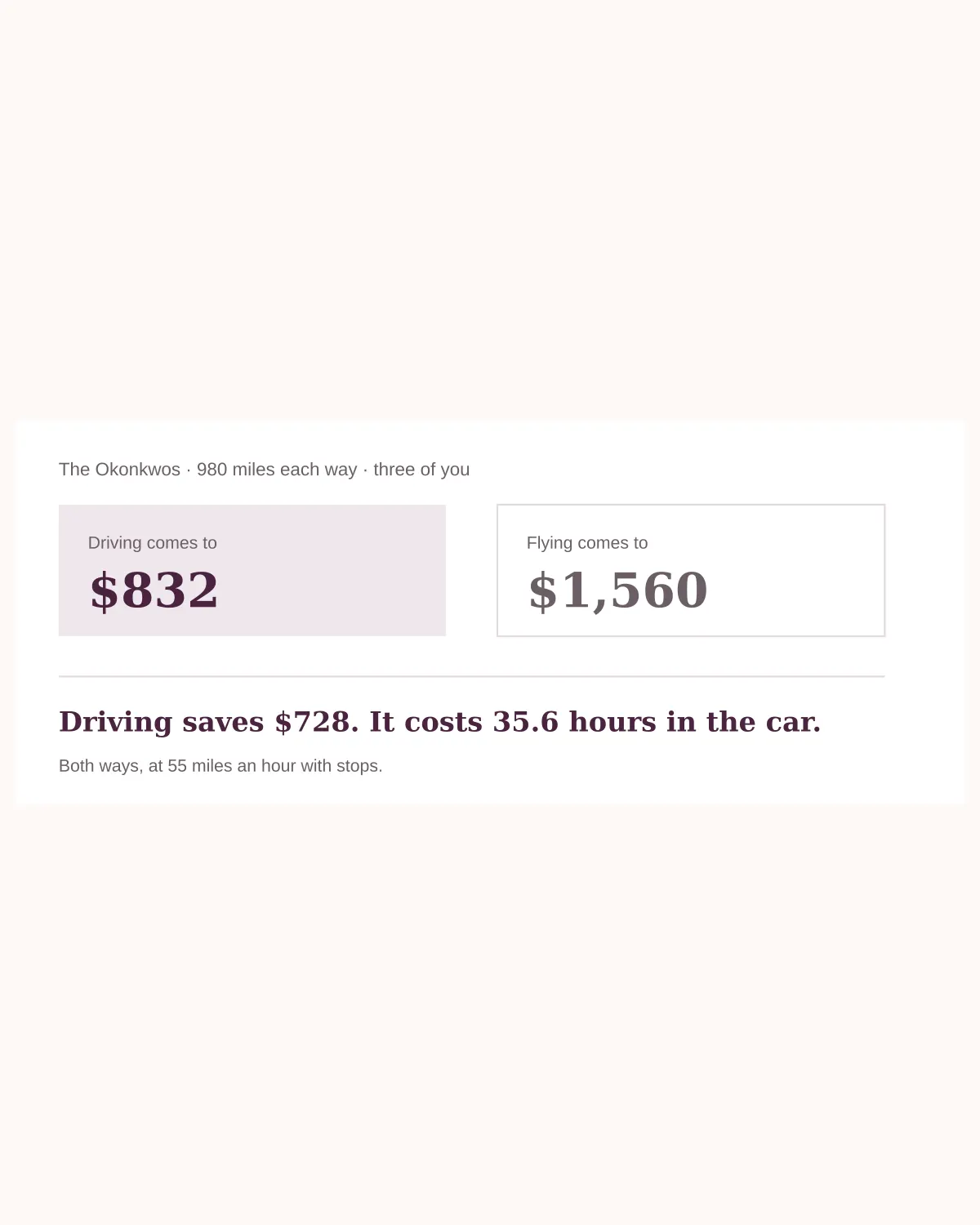
The Fly or Drive tab prices both options for both trips, using your own miles and your own fares. Then it says the part a price comparison usually leaves out: how long you will be in the car, both ways, at a realistic average speed. Sometimes seven hundred dollars is worth a day and a half of driving. Sometimes it is very much not, and you would rather know that before December than during it. It does not book anything and it does not quietly change your budget. It gives you the two numbers and leaves the decision where it belongs.
If both families are in the same town, you do not need this. There is no gap to measure and no fly-or-drive decision to make.
It assumes two trips and two people splitting the whole of December evenly. Three sets of parents will not fit, and if you divide money by share of income rather than in half, the settle-up block at the bottom will not be right for you — though everything above it still will.
It earns its place when one family is a long way further than the other, you are both paying for different parts of it, and December has a number attached to it that you have already quietly gone past once before.
Does the job. Splitting it per trip rather than one big total is what makes it useful — you can see which half of the plan is the expensive half.
My family is a four-hour drive, his is a flight. We have had the same argument about whose Christmas costs more every year since we married. Now we have a number instead of a feeling, and the number was not what either of us expected.
The gift budget, the Thanksgiving timeline, the blended-family gift tracker, the remote Secret Santa kit, the cookie swap planner, the two-families travel budget, the fifty-card Christmas list, the mixed-diet menu planner, the toddler activity calendar, and the ninety-day January debt reset. Bought separately they are $90.
Get all ten — $39